
TWO:It was at the close of 1719, when George I. returned from Hanover, that this Company proposed to Ministers to consolidate all the funds into one. It was strange that both Ministers and merchants could be deluded by the hope of enriching themselves by a share of the trade with the Spanish South American provinces, when Spain herself, in full enjoyment of them, was sunk into indigence and weakness, and presented the most determined resistance to the unfettered intercourse of any other nation with them. Yet Sir John Blunt, a leading director of the South Sea Company, persuaded the Ministers that by granting the Company power to deal with the public funds, and especially to buy up the unredeemable annuities which had been granted in the two preceding reigns, chiefly on terms of ninety-nine years, and which now amounted to about eight hundred thousand pounds a year, they could, in twenty-six years, pay off the entire National Debt. But, to enable them to do this, they must be empowered to reduce all the different public securities to one aggregate fund in their hands, to convert both redeemable and unredeemable debts into stock by such arrangements as they could make with the holders, and to have certain commercial privileges vested in them. Ministers accepted the proposals with great alacrity. Aislabie introduced the scheme to Parliament in the month of February, 1720, declaring that, if it was accepted by the House, the prosperity of the nation would be amazingly enhanced, and all its debts liquidated in a very few years. Craggs seconded the proposal in most sanguine terms, expressing his conviction that every member of the House must be ready to adopt so advantageous an offer. Ministers had already closed with the proposals of the Company, and they were themselves greatly disconcerted by the suggestion of Mr. Thomas Brodrick, the member for Stockbridge, who expressed his entire accordance with Ministers, but thought that the nation should endeavour to obtain the best terms for itself by opening the competition to every other company or association of men as well as that in question. Ministers were confounded by this proposal, and Aislabie endeavoured to get out of it by declaring that to do this would be like putting the nation up to auction, and that such things should be done with spirit. But Jekyll interposed, saying it was this spirit which had ruined the nation, and it was now requisite to consider seriously what was best for the public. A violent debate ensued, in which Walpole eloquently recommended open competition, and was sharply replied to by Lechmere. The question was carried in favour of competition; and then the Bank of England, which before had coolly declined to enter into the proposals, suddenly appeared in a new temper, and made liberal offers for the privilege of thus farming the public debts. But the South Sea Company was not to be outdone; it offered seven millions and a half, and the Bank gave way in despair."Or the nurse?"
THREE:[Pg 130]
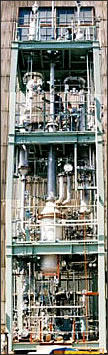
High quality is being demanded in many fields nowadays and so in order to satisfy that we developed a high-purity distillation system in collaboration with Ube industries, Ltd. and Kanto Chemical Co., Inc. The system is used to refine cleaning solutions for the semiconductor industry, medical materials, etc. of high purity (residual ion concentration: 0.01 to 1.0 ppb).
- Our High-purity distillation system provide our clients with high solvent recovery rate, almost 100%.
- The quality of the products/output from our system is very stable, which makes production management very easy, and easier than the conventional ion exchange resin method.
- No emission of waste brings our clients reduction of running cost for environmental measures.
- Our various devices minimize entrainment.
- To prevent the elution of metal, you could ask us the system made of Teflon.
- Our High-purity distillation system has been already proved for solvents that trigger very rapid decomposition reactions, such as hydrogen peroxide.
- Product guide
- Alcohol distillation
- Distillation equipment
- High-purity distillation system
- Membrane separation type solvent dehydration system
- Reactor
- Evaporative concentration equipment
- Coulter spray dryer
- Microwave treatment system
- Filter dryer
- OS filter (continuous vacuum rotating filter)
- Hydrocyclone (liquid cyclone)
- Thermal oil heater (heat medium boiler)
- Process air heater (air heater)
- Ammonia treatment system
- Catalytic deodorizing equipment for ammonia and VOC gas
- Stationary cryogenic storage tank
- Portable cryogenic container
- Cryogenic liquefied gas evaporator